Complexity is two problems, not one, and only one of them is yours to keep
FOX's latest research, The Multigenerational Family Journey (January 2026), maps the arc enterprising families travel through on two dimensions: time and complexity. This piece picks up the second. We break the word "complexity" into two parts that call for opposite responses.
Two kinds of complexity
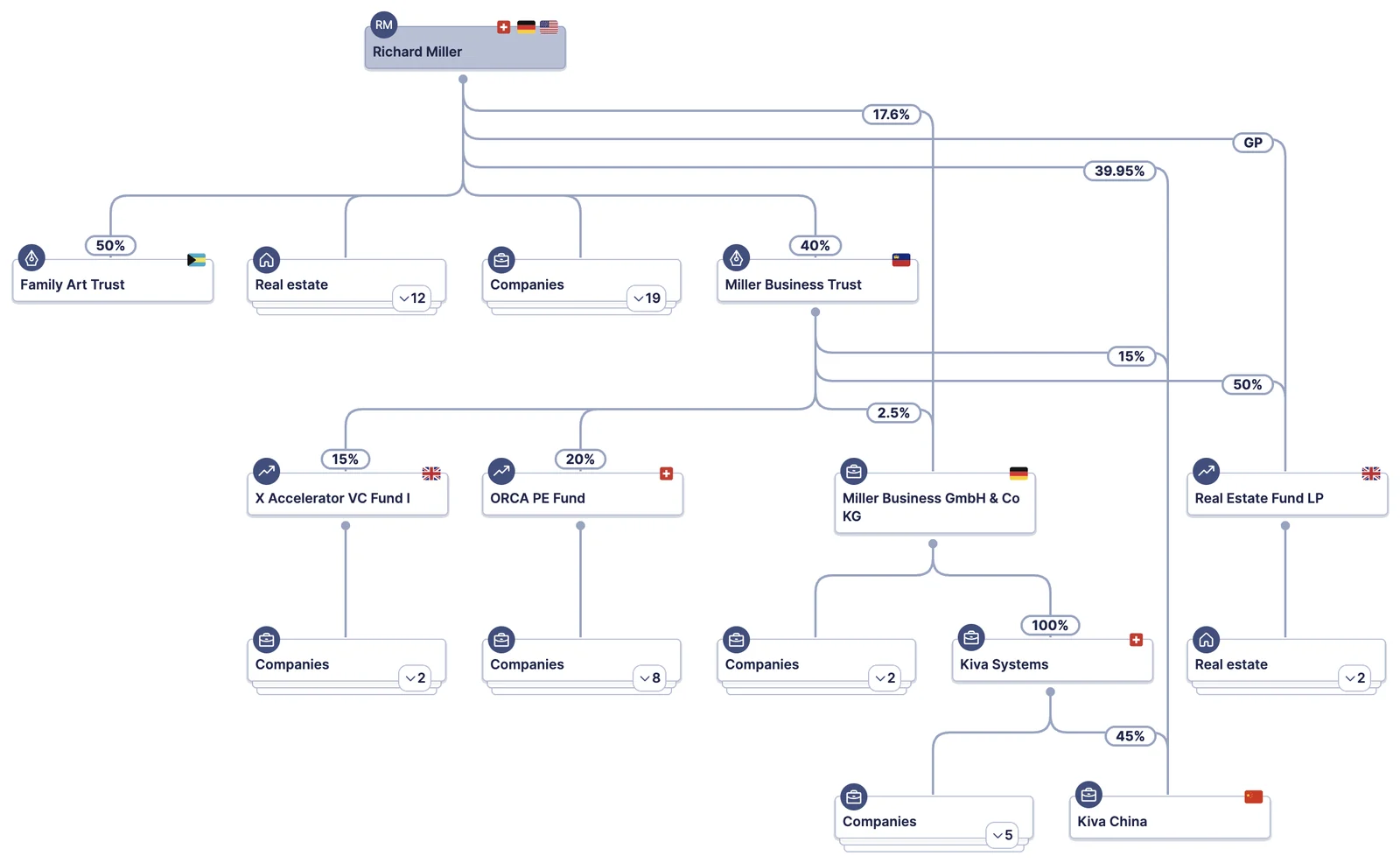
The first is structural. It lives in the family's legal reality: layers of entities, share classes that split economic interest from voting control, the same asset owned both directly and indirectly, trusts, inter-family loans, powers of attorney, and obligations that read as a loan in one document and equity in another. Some are legally intricate; others are mundane but rarely tracked well — a lapsed power of attorney can matter as much as a forgotten entity. Structural complexity makes a family's position hard to hold: to state accurately and prove on demand.
It is rarely modest in scale. The average family in a recent ORCA roundtable held over 300 legal entities across four countries; the largest held 1,300.
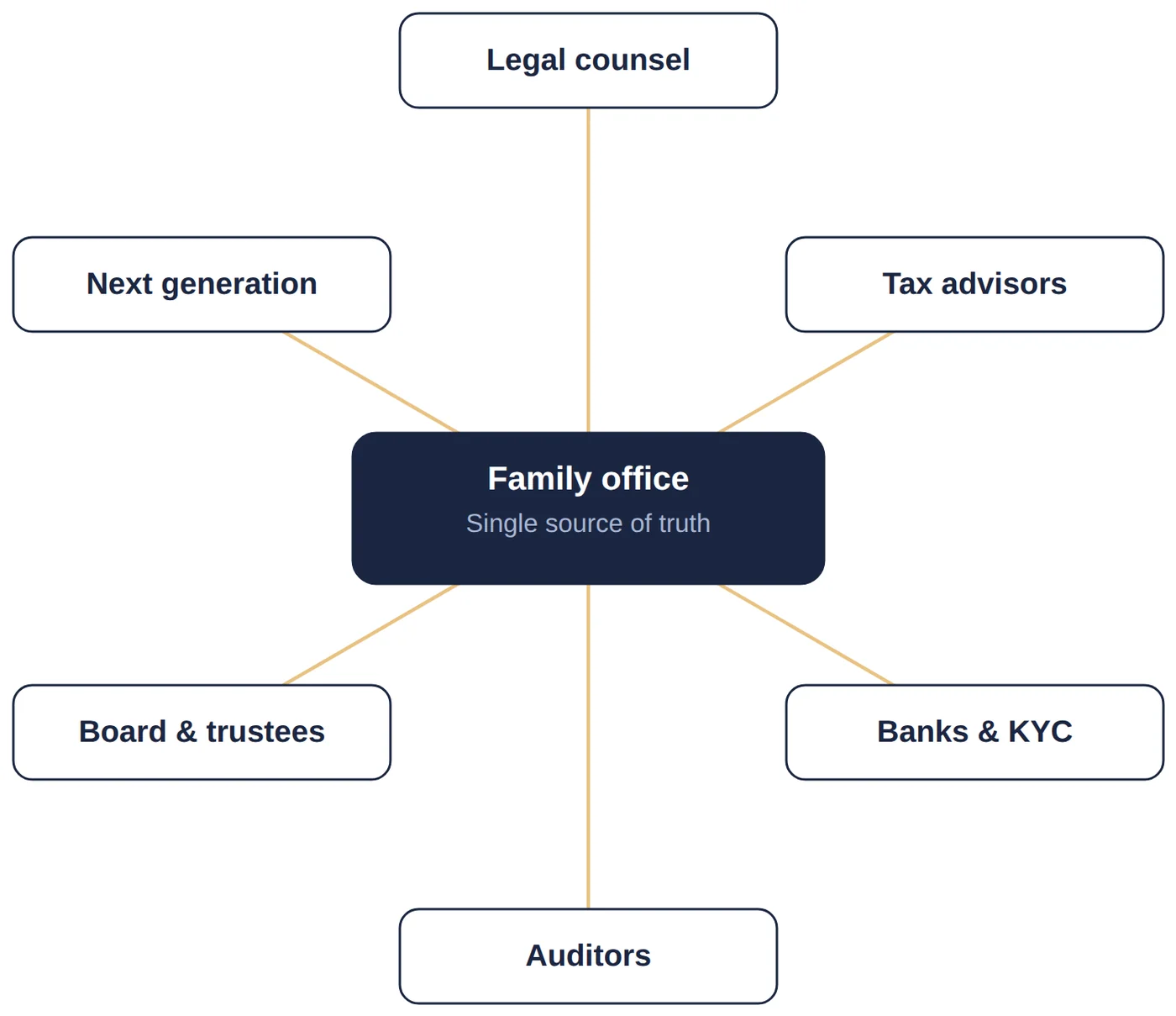
The second is coordination. It lives outside the structure, in the parties who must act on it: legal counsel, tax advisors across jurisdictions, banks running KYC, auditors, trustees, directors, and the rising generation. Coordination complexity is what makes a family's position hard to share: to get the right slice of truth to the right party, in the right form, at the right moment.
FOX's Journey Framework plots complexity as a single rising line. In practice it's two lines rising for different reasons. A family that just sold its operating business may have a simple structure — cash, no sprawl of entities — yet onboards a wave of new advisors and banks, so its coordination complexity spikes as structural complexity falls. An established family shows the opposite: a settled advisor set atop a structure of bewildering depth. Both complexities move independently, and knowing which is rising is the first step toward knowing what to do about it.
Own the data layer; outsource the work
Both complexities force the same decision: what do we build in-house vs. buy? The sensible default, long argued on FOXCast, is to outsource anything the market supplies well — a specialist tax firm or cross-border legal practice operating at a scale a single family cannot match. Which is why legal services are the most commonly outsourced function (52%, J.P. Morgan 2026). The expertise is better bought than built.
But there is a quiet confusion buried in that conclusion. Outsourcing the work is not the same as outsourcing the truth it runs on. The advice, the filings, and the opinions are services you buy. The underlying record of legal reality — which entities exist, who owns what through which chain, what each document says — is not: it is the foundation every outsourced specialist draws from, too vital to hold anywhere but in-house.
Consider how many of a family office's functions rely on this same dataset: a KYC request, an estate plan, a data room for a sale, a completeness check before an audit, the succession briefing for the next generation. The same source of truth, every time — yet for most families this truth is fragmented across tools and people, with counsel holding one piece, the administrator another, and the decisive context in one employee's head. Making every routine task an act of reconstruction. The family does not own its own picture — it rents fragments from the people it pays.
"The family does not own its own picture — it rents fragments from the people it pays."
That is tolerable until a transition — a death, a sale, a dispute, a generational handover — turns a slow inconvenience into an acute risk. J.P. Morgan's 2026 report finds 86% of family offices have no clear succession plan for key roles, and 33% rank dependence on a single individual or provider among their top continuity risks. This is why every family should own their data layer.
Why this is no longer the heavy lift it was
There is a reason families let this layer fragment: owning it was historically so laborious that fragmentation was rational. A current, document-backed picture of a 300-entity structure meant reading every shareholder agreement, deed, and resolution by hand, then keying in the facts and reconciling them — a standing effort few lean teams could justify.
AI has changed that calculus. It can now read legal documents and extract the structured facts they contain — ownership, rights, obligations, dates — tethering each fact back to the document that proves it: work that once took weeks, now in a fraction of the time.
But AI is not a magic wand, and this is the part most easily missed: a system of record is only as trustworthy as what goes into it, and deciding what goes in remains a human judgment. Point AI at a hundred documents in a shared drive and it will dutifully read all hundred — the early drafts, the superseded versions, the agreement that was never signed. It cannot yet reliably tell a work-in-progress from the live, legally binding document that actually governs. Only a person can draw that line. The promise is not that you click your fingers and AI assembles your truth; it is that AI removes the heavy lifting once a human has decided what counts as truth. Get that adjudication right and the rest follows; get it wrong and you have automated the fragmentation instead of fixing it. Owning the data layer no longer demands a department — it demands a decision, and the discipline to make it well.
Which returns us to the Journey Framework. Whatever cohort a family occupies, and whichever complexity is rising, the same principle holds: outsource the expertise, but own the legal-entity truth it depends on — too vital to rent, the foundation of nearly every function of the office, and, for the first time within reach.
ORCA gives families and their advisors one verified source of legal-entity truth, the third pillar alongside the ledger and performance reporting.
Sources: The Multigenerational Family Journey, FOX Foresight, January 2026, © Family Office Exchange. J.P. Morgan 2026 Global Family Office Report. UBS Global Family Office Report 2026. Julius Baer/PwC Family Barometer 2025. PwC Italy Family Office Survey 2026. FOXCast (Drew McMorrow; Amjed Saffarini). ORCA roundtable data (n=10, 2025).