The ORCA approach: one smart record of legal reality
Every entity-management product promises a single source of truth. The interesting question is not whether you have one, but whether you could prove it was right — to an auditor, a bank, or a counterparty's lawyer — on the day it mattered.
What actually makes this hard
Tax, legal and compliance are unforgiving in a specific way: the errors surface years later, at scale, and by then they are rarely fixable. Penalties, back-taxes and interest compound quietly. Directors and trustees can be held personally liable for what the record got wrong. A failed KYC check or a stalled transaction arrives at the least convenient moment in a deal.
Three properties of legal information make it resist ordinary tooling.
The detail carries the whole answer. 50% and 50.01% are not a rounding difference — control changes hands between them. A loan and equity are not two labels for the same capital. A date of 1 January rather than 31 December moves the tax year, and with it the answer.
The facts that matter are rarely one layer deep. Ultimate beneficial owners sit five layers up. Share classes split economics from control. Chains of powers of attorney, nominee shareholders, ownership that is direct and indirect at the same time. Spreadsheets, CRMs and databases capture direct connections well; in legal matters it is the indirect ones you most need to get your hands around.
And the decisive facts move. You need the past, for historical audits and proof of ownership chains. You need today, current and provable. And you need the futures you are considering, with the steps required to reach them.
The usual starting point
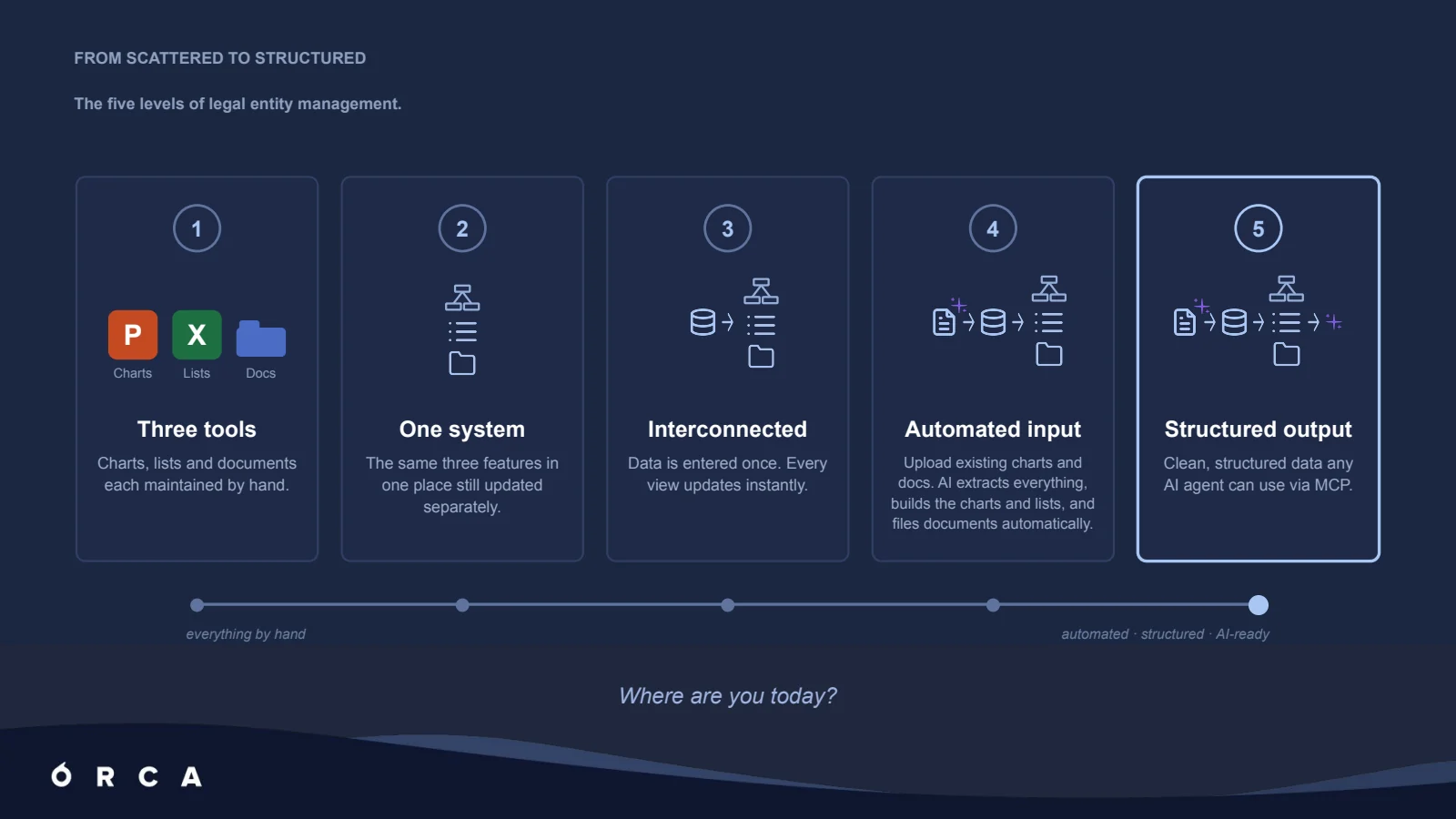
The most common response to that complexity is sensible on its face: pick a good tool for each piece. Charts in one, lists in another, documents in folders, and the decisive context in one person's head. Each choice is defensible. The trouble is that each drifts out of step with the others, and eventually nobody can fully trust any single view — which is the one thing the record was for.
Get ORCAnized, then orchestrate
The approach splits into two halves that are easy to confuse. The first is getting the truth right. The second is putting it to work. Most tools skip to the second.
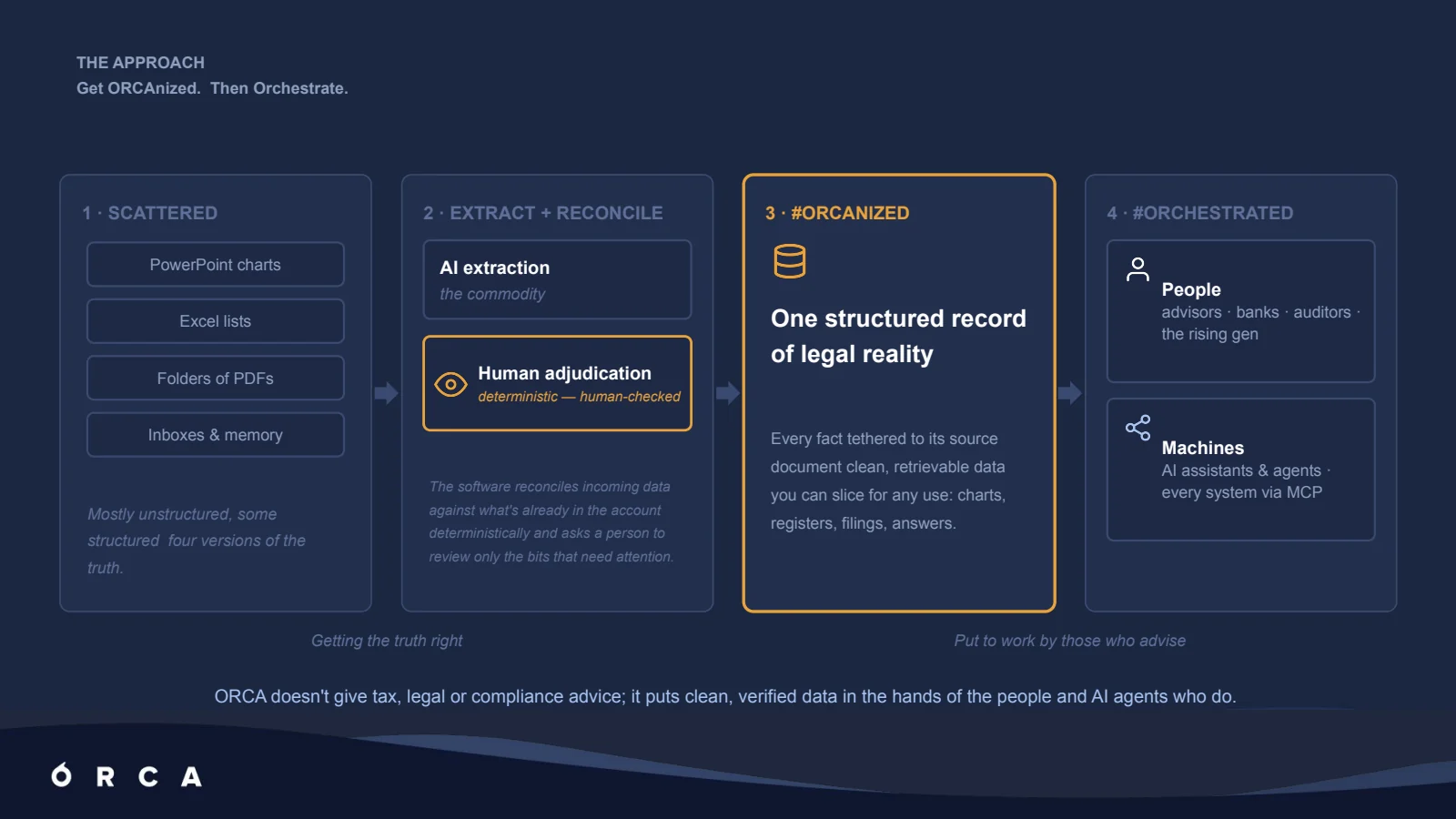
Extraction is the commodity half. AI reads the charts, agreements and PDFs you already have and proposes the facts inside them. What matters more is what happens next: the software reconciles those proposals against what the account already holds, deterministically, and asks a person to review only the parts that need a judgment. The record that results is structured, and every fact in it points back to the document that proves it.
Only then does orchestration make sense — advisors, banks, auditors and the rising generation drawing on the same verified record, and increasingly AI agents doing the same through MCP. ORCA does not give tax, legal or compliance advice. It puts clean, verified data in the hands of the people and systems that do.
Built from documents, not from typing
Legal relationships are born in documents, so the record is built from them and points back to them. That sounds obvious until you see the volumes involved. One client's filing system held roughly 90,000 documents. About 8,000 were live and legally binding; the remaining 82,000 were drafts, copies and superseded versions.
No amount of reading speed solves that. Deciding which 8,000 count is a human judgment, and it is the judgment everything downstream depends on. Point a model at all 90,000 and you have automated the confusion rather than resolved it.
The payoff for getting it right is concrete. In a dispute over one partner's stake, the same question was six weeks of legal and accounting archaeology without a system — and close to an instantaneous audit with one.
Facts as sentences, each carrying a date
Facts are stored as sentences built on verbs that carry legal meaning. "On 12 May 2024, Anna bought 100 shares of HoldCo AG" is a sale, with consideration paid. "On 12 May 2024, Anna was gifted 100 shares of HoldCo AG" is a gift, with entirely different tax and legal consequences. One word changes; everything downstream changes with it. The form is familiar enough for anyone to read and precise enough to hold the distinction.
Every fact also carries a date, which is what lets the record travel in time — rewind to any past date and prove the position as it stood, or model a future structure and the steps needed to reach it.
Why verification cannot be probabilistic
This is the part most easily lost in the current enthusiasm. AI is probabilistic by design. Ask it the same question twice and you may get two answers. That is a strength when reading and drafting, and a liability when verifying.
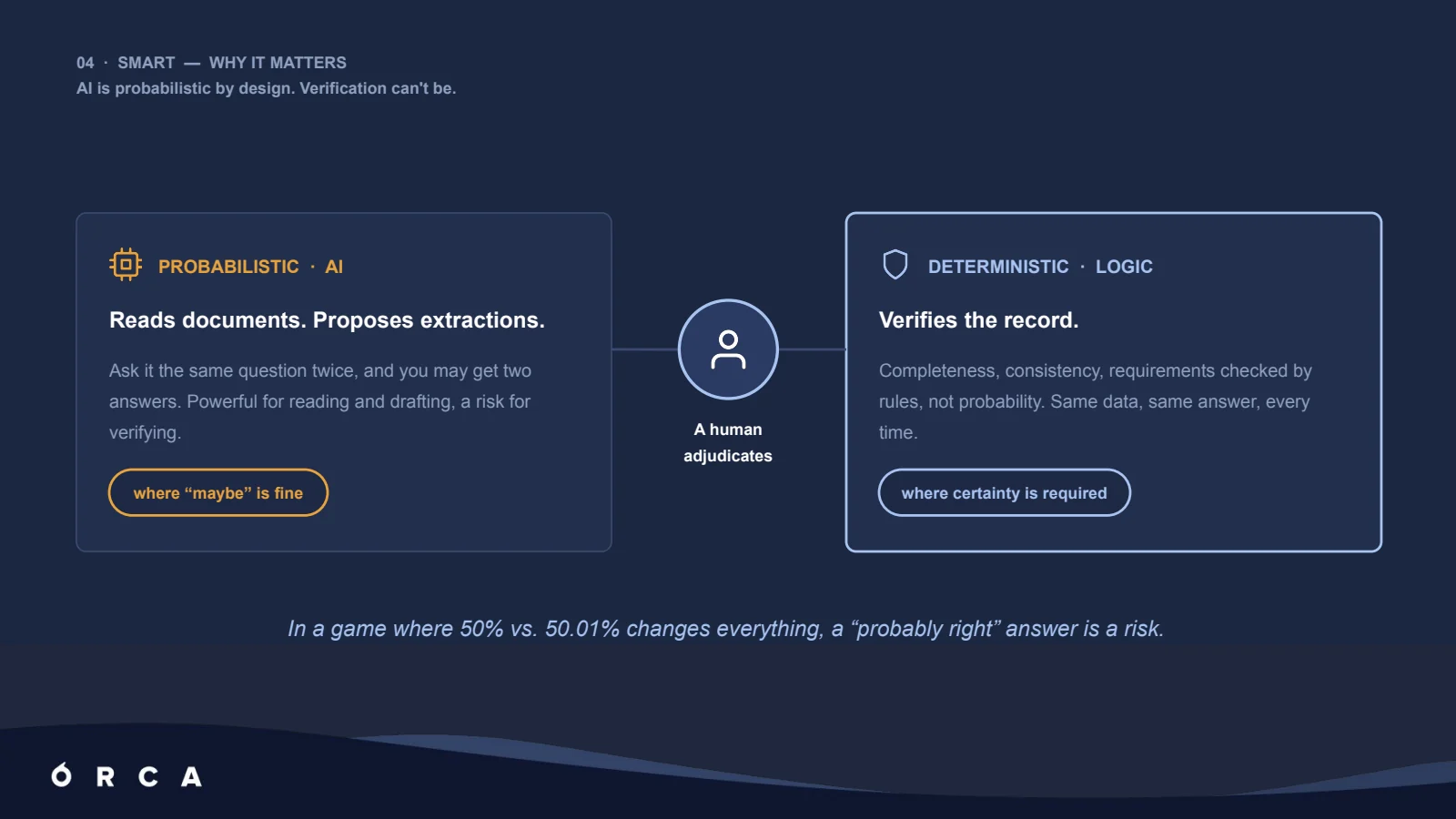
So verification runs on rules rather than probability — the same questions a careful professional would ask, asked automatically and identically every time. Is anything missing: a required incorporation deed absent, and a task created. Does anything contradict: ownership adding to 102%, and flagged. Is an obligation triggered: a new entity meaning a filing is due. Same data, same answer, every time.
In a game where 50% and 50.01% change the outcome, a "probably right" answer is not an answer.
What it produces
The result is unglamorous and that is rather the point: one record, with a hundred uses. KYC requests, UBO filings, tax filings, audits, bank onboarding, structure charts, transactions, M&A due diligence, board meetings, handovers — all drawing on the same verified picture rather than being reconstructed from scratch each time.
What that has been worth in production: tax reporting cut from three or four weeks to one across 800+ legal entities at Billingsley Company; around 70% of the AML compliance workload and roughly 90% of structure-chart production time saved at Staiger Law; 20 hours of manual work saved per client, per report at Aster Coop.
All of it sits on a foundation only the client can open: zero-knowledge encryption, where keys never leave the browser, an immutable ledger so changes cannot be silently rewritten, and a Swiss-hosted vault. Security that is structural rather than promised.
ORCA gives families, operators and their advisors one verified source of legal-entity truth — the third pillar alongside the ledger and performance reporting.